Problem Set 2
P2.1 Logistic Equation
The logistic equation models the growth of a population with intrinsic growth rate \(\alpha > 0\) and carrying capacity \(\kappa > 0\) (the limiting population as \(t \to \infty\)): \[ \left \{ \begin{aligned} \dot{y}(t) & = \alpha y(t)\left(1 - \frac{y(t)}{\kappa}\right), \quad t > 0, \\ y(0) & = y_0. \end{aligned} \right. \]
- Show that the solution of this initial value problem is \[ \forall t > 0, \quad y(t) = \frac{\kappa}{1 + \frac{\kappa - y_0}{y_0}\exp(-\alpha t)}. \]
For the remainder of the exercise, take \(\alpha = 1\), \(\kappa = 2\), and \(y_0 = 1\).
Apply the Forward Euler method with time step \(\tau = 0.1\). Compute the numerical approximation up to \(t = 0.3\).
Compare the numerical approximation with the exact solution. Reproduce and complete the table below.
| \(n\) | \(t_n\) | \(y(t_n)\) (exact) | \(y_n\) (numerical) | \(\lvert y_n - y(t_n) \rvert\) |
|---|---|---|---|---|
| \(0\) | \(0\) | \(1\) | \(1\) | \(0\) |
| \(1\) | \(0.1\) | |||
| \(2\) | \(0.2\) | |||
| \(3\) | \(0.3\) |
P2.2 Blasius Boundary Layer Problem
The Blasius equation arises in boundary layer theory. It describes the steady, two-dimensional, incompressible laminar flow over a semi-infinite flat plate aligned with a uniform free stream.
After similarity reduction of the Navier–Stokes equations, the problem reduces to the nonlinear boundary value problem: \[ u'''(x) + u(x)\,u''(x) = 0, \] subject to the boundary conditions \[ \left\{ \begin{aligned} u(0) &= 0, \\ u'(0) &= 0, \\ u'(\infty) &= 1. \end{aligned} \right. \]
What is the order of this ODE? Rewrite it as a system of first-order ODEs.
Show that the Blasius equation and the boundary conditions at \(x=0\) are invariant under the scaling transformation (\(c \neq 0\)) \[ \begin{aligned} \overline{u} &= c\,u, \\ \overline{x} &= \frac{x}{c}. \end{aligned} \]
Under this transformation, \(\overline{u}\) satisfies the same differential equation as \(u\), but the condition at infinity is replaced by \[ \overline{u}''(0) = 1. \]
Define \[ \alpha = \overline{u}'(\infty). \]
Show that choosing the scaling constant \[ c = \sqrt{\alpha} \] leads to the normalization condition \[ u'(\infty) = 1. \]
Propose a numerical method to solve this boundary value problem. (Indicate clearly how you would treat the condition at infinity.)
P2.3 Planar Three-Body Problem
We consider three point masses \(m _ i > 0\) moving in the plane, with positions \(\underline{r _ i} \left ( t \right ) \in \mathbb R ^ 2\) and velocities \(\underline{v _ i} \left ( t \right ) \in \mathbb R ^ 2\), for \(i = 1\), \(2\) and \(3\). The only force is Newtonian gravity.
This is a classical problem in celestial mechanics, and it is known that no closed-form solution exists for the general case. We will study a particular periodic solution, known as the figure-eight solution, which was discovered numerically by Moore in 1993 and later proved to exist by Chenciner and Montgomery in 2000.
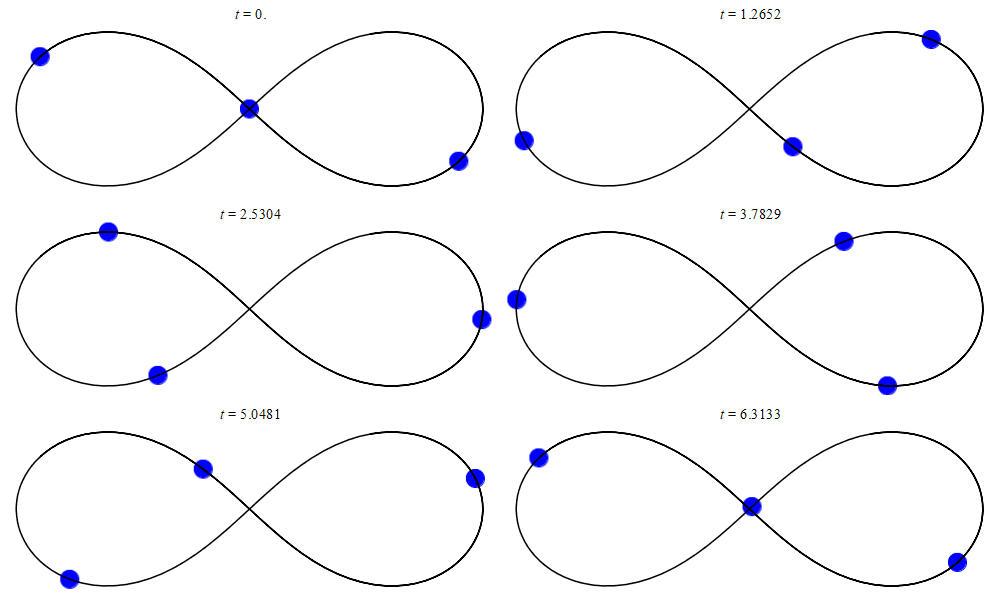
Modeling
Starting from Newton’s law \(m _ i \underline{\ddot r _ i} = \underline{F _ i}\) and the gravitational interaction between pairs, show that \[ \dot r_i = v_i, \qquad \dot v_i = \sum_{j\neq i} G m _ j \frac{\underline{r _ j} - \underline{r _ i}}{\left \Vert \underline{r _ j} - \underline{r _ i} \right \Vert ^ 3}, \qquad i = 1,2,3, \] where \(G\) is the gravitational constant.
Write the system as a first-order ODE \(\dot q \left ( t \right ) = f \left ( t, q \left ( t \right ) \right )\) in \(\mathbb R ^ {12}\) by defining \[ y = \left ( \underline{r _ 1}, \underline{r _ 2}, \underline{r _ 3}, \underline{v _ 1}, \underline{v _ 2}, \underline{v _ 3} \right ). \] Give the explicit expression of \(f \left ( t, q \left ( t \right ) \right )\).
Show formally that the following quantities are invariants of the exact dynamics:
- Total linear momentum \[ \underline P = \sum _ i m_i \underline{v _ i} \]
- Center of mass position \[ \underline R = \frac{1}{M} \sum _ i m _ i \underline{r _ i} \quad \mathrm{with} \quad M = \sum _ i m _ i \]
- Total energy \[ E = \sum _ i \frac 1 2 m _ i \left \Vert \underline{v _ i} \right \Vert ^ 2 - \sum _ {i < j} \frac{G m _ i m _ j}{\left \Vert \underline{r _ i} - \underline{r _ j} \right \Vert} \]
Numerical experiment (dimensionless units)
To avoid very large/small physical constants, use the dimensionless choice \(G = 1\) and take equal masses (\(m _ 1 = m _ 2 = m _ 3 = 1\)). The initial condition (a famous periodic solution of the three-body problem) in the plane: \[ \begin{aligned} r _ 1(0) & = ( \;\;0.97000436,\; -0.24308753), \\ r _ 2(0) & = (-0.97000436,\; \;\;0.24308753), \\ r _ 3(0) & = (0,\;0), \end{aligned} \] and \[ \begin{aligned} v _ 1(0) &= ( \;\;0.466203685,\; 0.432365730), \\ v _ 2(0) &= ( \;\;0.466203685,\; 0.432365730), \\ v _ 3(0) &= (-0.93240737,\; -0.86473146). \end{aligned} \]
Verify from the initial data that:
- The center of mass is at the origin and remains there (at least at \(t = 0\)).
- The total linear momentum is zero at \(t = 0\).
Integrate the system over \(t \in \left [ 0, T \right ]\) with \(T = 10\) using a constant time step \(\tau\) (try \(\tau = 10 ^ {-2}\) and \(\tau = 5 \times 10 ^ {-3}\)). Do this with:
- Forward Euler
- Runge-Kutta 2
- Midpoint rule
For each method and each (h), compute and plot versus time:
- The energy error (\(E \left ( t \right ) - E \left ( 0 \right )\))
- The momentum norm (\(\left \Vert \underline P \left ( t \right ) \right \Vert\))
- The center of mass drift (\(\left \Vert \underline R \left ( t \right ) \right \Vert\))
Plot the planar trajectories of the three bodies and comment:
- Does the motion remain bounded?
- Do you observe a qualitative difference between methods?
- Which method best preserves invariants for a given step size?